Chronically Tight Hamstrings: Why Sitting Shortens Them and Stretching Alone Won't Fix It
Tight for years, no matter how much you stretch — and the first to complain when you train. The desk worker's hamstring problem, explained and fixed.
Undo The Desk is reader-supported. When you buy through links on this page we may earn an affiliate commission, at no extra cost to you. How we make money.
Touch your toes. If your fingertips stall mid-shin — and they’ve stalled there for years despite every stretching phase you’ve ever started — your hamstrings have a desk problem, not a discipline problem. And if the rare weekend you do train hard, it’s the hamstrings that pull, twinge, or stay sore for five days: same problem, sharper edge.
This is the hub page for the desk worker’s hamstring pattern. The uncomfortable headline: your hamstrings probably aren’t short — they’re weak, guarded, and neurally tense. That’s why ten years of toe-touch attempts changed nothing, and it’s why the fix below spends more time loading them than stretching them.
Why sitting ruins hamstrings without even shortening them
Here’s the paradox: in a chair, your knees are bent — which puts the hamstrings near their shortened position — but your hips are flexed, which puts the upper hamstrings under stretch. Net effect after years: confused, deconditioned tissue that the nervous system stops trusting. Three mechanisms drive the felt “tightness”:
- Protective tension, not short tissue. Your nervous system sets muscle tone based on how much it trusts the muscle’s strength in a given range. Weak hamstrings near end range get a guard rail of tension thrown up early — the stretch “wall” you hit is your brain’s circuit breaker, not collagen at full length. This is why a good warm-up suddenly buys you four extra inches: trust, temporarily granted.
- Neural tension from upstream. The sciatic nerve runs the length of the hamstring. Years of sitting — hip compression, anterior pelvic tilt, the occasional grumpy lumbar disc — leave the nerve tracking less freely, and a tensioned nerve reads exactly like a tight hamstring, except it never improves with stretching. (Quick tell below.)
- Anterior pelvic tilt pre-lengthens them. Tight hip flexors tip your pelvis forward, which drags the hamstring origins up and back. Your hamstrings spend all day slightly pre-stretched — so they test “tight” while actually being long. Stretching a pre-lengthened muscle harder is how desk workers end up with proximal hamstring tendinopathy, the deep sit-bone ache that takes months to clear.
That third mechanism is why this page and the hip tightness guide are a package deal: the hips set the pelvis, the pelvis sets the hamstring length, and no hamstring protocol survives a pelvis that’s tipped wrong.
Sort yourself:
- Stiff, achy, “tight” feeling — worse after sitting, warms up with movement: the standard pattern. The protocol below is built for you.
- Tightness down the whole back of the leg into the calf, worse when you add a chin-tuck or flex your foot during a stretch: neural tension. Stretching is the wrong tool; the sliders below (nerve glides) are the right one.
- A pinpoint deep ache right at the sit bone, worse after sitting on it and worse from aggressive stretching: proximal hamstring tendinopathy territory. Stop stretching it entirely; eccentric loading is the treatment, slowly.
- Sudden sharp pain mid-sprint or mid-deadlift, bruising, or a divot you can feel: that’s a strain — acute injury rules apply, and a clinician beats a content site.
The protocol: load first, lengthen second
Ten minutes, daily where noted. The strength pieces are the engine; the stretches are the steering.
1. Romanian deadlift pattern — 3 sets, 3×/week
The single most valuable hamstring exercise for desk workers, because it loads the hamstrings long — exactly where they’re weakest and where the brain’s guard rail sits. Dumbbells, a band, or a backpack of books: soft knees, push the hips back, flat back, lower until you feel real hamstring tension, stand by driving hips forward. Three seconds down every rep, 10–12 reps. Strength earned at end range is rate-limiting for everything else on this page; the full progression lives in our posterior chain recovery guide, and the equipment-light version is in the budget home gym setup.
2. Hamstring sliders or Nordic negatives — 2 sets, 2–3×/week
Eccentric capacity is what makes hamstrings durable. Sliders: bridge up on your heels (socks on hardwood, or furniture sliders), walk the heels slowly out, drag them back. Nordic negatives if you have an anchor for your ankles: lower yourself forward as slowly as pride allows. These are the exercises that turn “first to pull when I train” into a memory.
3. Active straight-leg raise — daily, 2×10 per side
On your back, one leg flat, raise the other with a flexed foot and straight knee as high as it goes under its own power, lower slow. This is mobility you own — active range — and it converts the passive range the next drill rents.
4. Banded end-range stretch — daily, 90 seconds per side
On your back, band or strap around the foot, leg toward the ceiling at the first real barrier. Then make it active: contract the hamstring into the band for five seconds, relax, take up the new slack. Three or four cycles. Contract-relax recruits the nervous system into granting range instead of fighting it — it outperforms passive hanging by a wide margin. The long loops in a basic band kit are built for exactly this:
Bodylastics Stackable Resistance Bands Set
The most useful $75 a desk worker can spend on home equipment. Bands cover glute activation, posterior-chain warm-ups, and full-body strength in a footprint that fits in a closet.
Pros
- + Stackable up to ~140 lbs — covers everything from clamshells to glute-focused pull-throughs
- + Carabiner attachment system swaps tubes faster than the competition
- + Door anchor + ankle straps + handles included — a near-complete band gym in one box
- + Inner cord prevents catastrophic snap-back if a tube fails
Cons
- – Tubes can pinch the door anchor on first uses — break it in slowly
- – Color/weight system requires a minute to memorize
5. Nerve glides — only if you flagged neural, daily, 60 seconds
On your back, hip at 90 with hands behind the thigh: slowly straighten the knee while pointing the toes, then bend while flexing the foot. Ten smooth reps per side, gliding up to tension, never into pain. If your “tightness” is neural, two weeks of this will move you further than two years of stretching did.
6. Tissue prep — optional, 2–3 minutes before the above
Dense, guarded hamstring tissue accepts the work better after downregulation. For self-myofascial work the hamstrings are the body part where firm beats soft — they sit deep behind a layer you have to get through, and a soft roller just upsets the surface:
RumbleRoller Original (Firm)
The right roller for desk workers with stubborn, long-term hip flexor and IT band tightness. If a smooth roller hasn't moved the needle after a month of use, this one will.
Pros
- + Aggressive bumps actually penetrate hip flexor and IT band tissue
- + Far more effective on dense glute and quad knots than smooth rollers
- + Closed-cell foam doesn't break down — ours is going on year four
Cons
- – Painful for beginners — start with the soft (blue) version if you've never rolled aggressively
- – Bumps grab on bare skin — wear shorts/leggings
- – Overkill for upper-body work
For the genuinely concrete posterior chain — the decade-of-sitting kind — percussion with real amplitude reaches what bodyweight rolling can’t, and it’s the tool we reach for on the worst tissue. The full head-to-head of every gun we’ve tested on exactly this body part is in the massage gun guide:
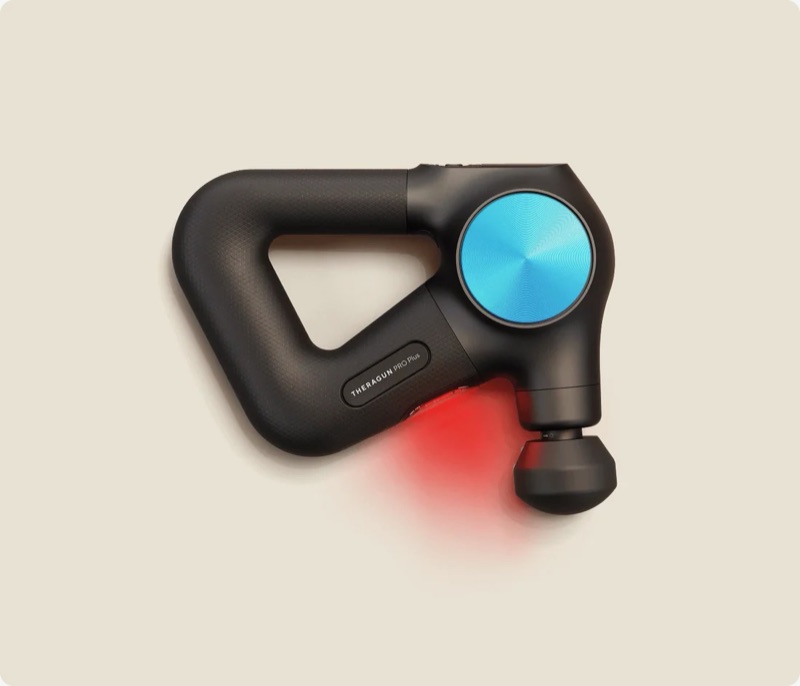
Theragun Pro Plus
The deepest-reaching massage gun on the market and the only one that genuinely solves chronic posterior-chain tightness for desk workers. If you can stomach the price, this is the buy.
Pros
- + Industry-leading 16mm amplitude reaches deep into glutes and hamstrings
- + 60 lb stall force — does not bog down on dense tissue
- + Six built-in modes including heat, cold, red light, and vibration
- + Ergonomic multi-grip handle so you can actually reach your own hamstrings
- + OLED screen with guided routines for posterior chain
Cons
- – Premium price
- – Heavier than the competition (2.9 lb)
- – App pairing can be finicky on first setup
The desk-side tax
Same principle as every pattern on this site: the protocol undoes, the workday redoes — slow the redoing.
- Stand or change leg position every 30–45 minutes. A 20-second hip hinge at your desk (hands on the desk, hips back, flat back) is a free hamstring rep.
- Fix the pelvis, fix the hamstrings: the hip flexor protocol is the other half of this page. Anterior tilt is upstream of almost everything here.
- Sit on your sit bones, not your sacrum. The slumped-pelvis position both compresses the hamstring origin and feeds the neural tension pattern. A chair that holds your pelvis upright helps — that’s half of what we test in the office chair guide.
What to expect
- Week 1–2: The contract-relax stretching buys visible range almost immediately — that’s the nervous system, not tissue, and it proves the guard-rail model. RDLs are humbling.
- Week 3–4: Toe-touch distance improves and holds between sessions. Training soreness drops from five days to two.
- Month 2–3: This is where actual tissue adaptation lives. End-range strength compounds; the “first thing to pull” reputation quietly retires.
- Plateau or sit-bone pain: re-read the sorting list — you’re probably loading a tendinopathy or stretching a nerve. Adjust accordingly, and bring in a professional if it persists.
Frequently asked questions
Why are my hamstrings always tight no matter how much I stretch?
Because in most desk workers the hamstrings aren't actually short — they're weak at end range and neurally guarded, so the brain throws up a protective tension wall that feels identical to shortness. Passive stretching never addresses the weakness, so the wall comes back by morning. Loading the muscle long (Romanian deadlifts, sliders) plus contract-relax stretching changes the guard rail; stretching alone just argues with it.
Can tight hamstrings cause lower back pain?
Yes, but usually as an accomplice rather than the mastermind. Genuinely restricted hamstrings make your lumbar spine round early when you bend, which loads the back — but in desk workers the more common chain runs the other way: tight hip flexors tip the pelvis, the tipped pelvis pre-tensions the hamstrings AND compresses the lumbar. Treating hips, hamstrings, and back as one system is why those three guides on this site cross-reference constantly.
Should I stretch my hamstrings every day?
Active end-range work daily, yes — the straight-leg raises and 90-second contract-relax holds respond to frequency. Aggressive passive stretching daily, no, and never first thing in the morning when discs are most hydrated and protective tone is highest. And if your pain is a deep ache at the sit bone, stop stretching entirely — that pattern (proximal tendinopathy) is aggravated by stretch and treated by slow loading.
Is it better to foam roll or massage gun tight hamstrings?
Both downregulate tone before stretching or training; they differ in depth and effort. Hamstrings are dense and sit deep, so a firm roller works where a soft one just polishes the surface — and a high-amplitude massage gun reaches deeper still with less effort, which is why it's our pick for the worst tissue. Either way the window it opens is 20–30 minutes: do your loading and stretching inside it, or the gun was just a pleasant buzz.
How long does it take to fix tight hamstrings from sitting?
Range comes fast — contract-relax work typically buys visible toe-touch progress inside two weeks, because the first barrier is neurological. Keeping it is slower: end-range strength that makes the gain permanent takes six to twelve weeks of twice-weekly loading. The honest schedule is "noticeably better this month, durably different this quarter."
Where this fits
Hamstrings are the middle link of the posterior chain — downstream of the pelvis and hip flexors, wired into the same system as the lower back, and the body part where our massage gun testing earns its keep. Run this protocol inside the full posterior chain system and the toe touch comes back — load first, lengthen second, and stop blaming your discipline for what the chair did.