Neck and Shoulder Pain From Desk Work: The Forward-Head Fix
Tension headaches, burning trap knots, a neck that cracks every time you turn it — the desk-worker package deal. Here's the mechanism and the fix, in that order.
Undo The Desk is reader-supported. When you buy through links on this page we may earn an affiliate commission, at no extra cost to you. How we make money.
If your upper traps feel like bridge cables by mid-afternoon, your headaches start at the base of your skull and crawl forward, or turning to check your blind spot has become a whole-torso event — you’re holding the desk worker’s most common pain pattern. It has one root cause, it’s almost entirely mechanical, and it responds faster to treatment than any other problem we cover.
The root cause is your head’s position, not your neck’s strength. Fix the position and the pain dissolves. Skip the position and every massage, stretch, and gadget is a temporary discount on pain that’s still accruing.
The mechanism: your head is heavy and your monitor is low
A human head weighs 10–12 pounds balanced over the spine. Tilt it forward and physics takes over: at roughly 15 degrees of forward tilt, your neck muscles support around 27 pounds of effective load; at 45 degrees — a normal laptop slouch — closer to 50. Your upper trapezius and levator scapulae weren’t designed to hold a bowling ball at arm’s length for eight hours, so they do the only thing muscle can do under endless low-grade load: brace, shorten, and eventually file pain complaints.
The posture has a name — forward-head posture, with its sidekick rounded shoulders — and it self-reinforces in a loop:
- The screen sits too low, so your head drifts forward and down to meet it.
- Upper traps and levator brace to hold the cantilevered weight; they’re now working isometrically all day.
- Chest and front-shoulder muscles shorten as your shoulders round toward the keyboard.
- Deep neck flexors and mid-back muscles switch off — they’re the postural team that should be doing this job, and they atrophy on the bench.
- The weaker the right muscles get, the more the wrong ones brace. Repeat for a career.
Tension headaches enter through the suboccipitals — the small muscles where your skull meets your spine, which shorten hardest in forward-head posture and refer pain up over the scalp. If your headaches start at the skull base and end behind your eyes, that’s the signature.
Red flags first: pain, numbness, or tingling running down an arm; weakness in a grip; headaches that wake you at night or arrive with vision changes. None of those are “desk tightness” — they’re nerve or vascular territory and deserve a clinician, not a content site.
Step 1: Raise the screen (this is 50% of the fix)
The top of your monitor should sit at or just below eye level, an arm’s length away. For laptop users that’s physically impossible without help — the screen and keyboard are welded together — so the non-negotiable desk-worker purchase is separation: a stand or a stack of books under the laptop, plus an external keyboard. A monitor arm is the cleaner version of the same fix and pays for itself in adjustability.
Two details people miss:
- Glasses change the math. Progressive lenses make you tilt your chin up or down to find the focal zone — if your neck hurts and you wear progressives, your monitor probably needs to sit lower than the standard advice, or you need dedicated screen glasses.
- Standing desks don’t fix head position by themselves. The screen has to rise with your eyeline standing too — full setup math is in our standing desk guide.
Step 2: The daily 8-minute protocol
Same philosophy as every protocol on this site (the system lives in our posterior chain recovery guide): release what’s short, strengthen what’s sleeping, daily, low intensity.
Chin tucks — 3 sets of 10
The single most valuable neck exercise, and the dorkiest looking. Sitting tall, glide your head straight back — making a double chin — without tilting up or down. Hold two seconds. This is a rep for the deep neck flexors, the muscles that should be holding your head where the traps currently moonlight. Do a set at your desk every couple of hours; nobody on the video call can tell.
Band pull-aparts — 3 sets of 15
Arms straight out front, light band between your hands, pull it apart until your shoulder blades pinch, control it back. This wakes the mid-traps and rhomboids — the rounded-shoulder antidote — and doubles as a pressure release valve mid-workday. A light band lives permanently on our desk for exactly this:
Bodylastics Stackable Resistance Bands Set
The most useful $75 a desk worker can spend on home equipment. Bands cover glute activation, posterior-chain warm-ups, and full-body strength in a footprint that fits in a closet.
Pros
- + Stackable up to ~140 lbs — covers everything from clamshells to glute-focused pull-throughs
- + Carabiner attachment system swaps tubes faster than the competition
- + Door anchor + ankle straps + handles included — a near-complete band gym in one box
- + Inner cord prevents catastrophic snap-back if a tube fails
Cons
- – Tubes can pinch the door anchor on first uses — break it in slowly
- – Color/weight system requires a minute to memorize
Doorway pec stretch — 90 seconds per side
Forearm on a doorframe, elbow at shoulder height, step through until the front of your chest and shoulder lengthens. You’re unshortening step 3 of the loop. Breathe; don’t bounce.
Suboccipital release — 2 minutes
Lie on your back, lace your fingers behind your skull, and let your thumbs (or two firm massage balls in a sock) press into the soft spots just below the skull ridge. Slow nods, slow no’s. If your headaches live there, this is the two minutes you’ll feel immediately.
Optional: percussion for the traps — 2 minutes
A massage gun on upper traps and levator downregulates the brace before the strength work. Upper-body tissue is thin — this is where a small, light gun beats the big guns, and where heat genuinely helps:
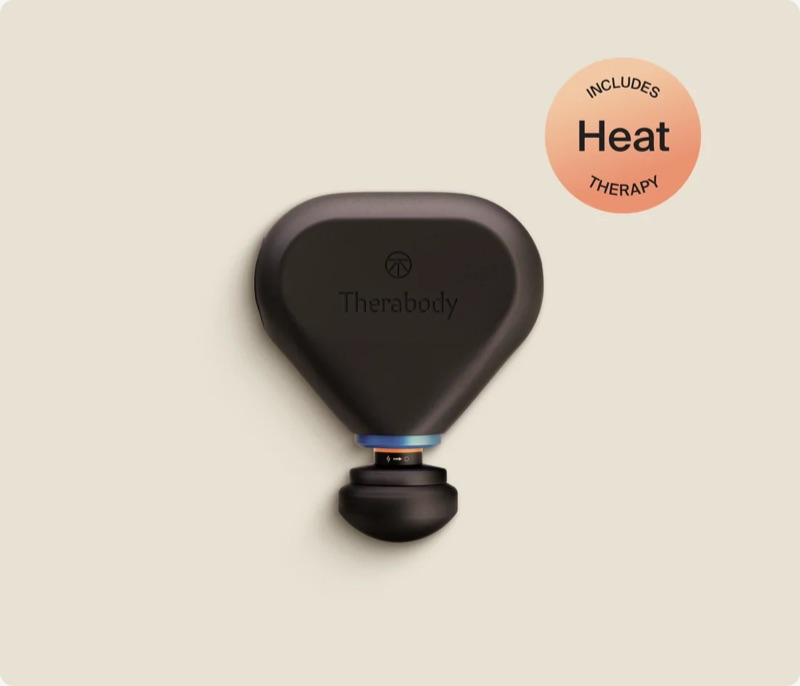
Theragun Mini Plus
The travel gun for desk workers who want heat with their percussion. The heat is the real upgrade — not depth — so if you only need portable percussion, the cheaper standard Mini is the smarter buy. Get the Plus if warming up tight tissue on the road matters to you.
Pros
- + Adds genuine heat (up to 131°F) to pre-warm tight tissue before percussion
- + Bluetooth + Therabody app with guided routines and pressure feedback
- + Still genuinely portable — fits a bag, USB-C, 120-minute battery
- + Triangle grip lets you reach your own glutes and hamstrings without contortions
Cons
- – 10mm amplitude is shallower than the standard $199 Mini's 12mm — less deep-tissue reach
- – 20 lb stall force bogs down on dense, year-old glute knots
- – $280 is a big jump over the standard Mini — you're paying for heat, not depth
- – Heavier than the standard Mini (~2 lb)
If you’re noise-sensitive or sharing office walls, the quietest premium option we’ve tested is the better desk companion:
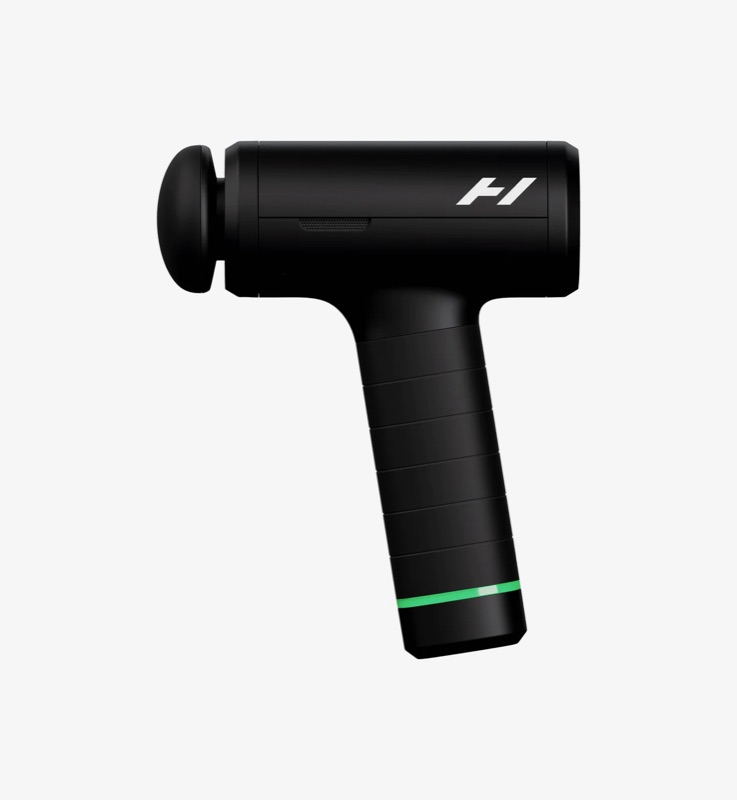
Hypervolt 3 Pro
The best value at the premium tier. If you don't have severe glute knots, this gives you 90% of the benefit of the Theragun Pro Plus for $100 less.
Pros
- + Quietest premium massage gun we tested — usable in a shared apartment
- + Pressure-sensor tech tells you when you are pushing hard enough
- + 14mm amplitude is enough for most desk-worker tightness
- + Lighter than the Theragun (2.5 lb) — easier one-handed use
- + Integrates with the Hyperice app for guided routines
Cons
- – 14mm amplitude trails the Theragun Pro Plus
- – Stall force lower (~50 lb) so it can bog down on dense glutes
- – Battery life trails the leader at high speeds
One honest warning: percussion on the side of the neck itself is a bad idea — too many structures you don’t want to hammer (carotid, brachial plexus). Traps, levator attachment, rhomboids, pecs: yes. Throat-adjacent anything: no.
Step 3: Break the hold pattern
Isometric bracing is the engine of this whole problem, and the cheapest fix is interruption. Every 30–45 minutes: shoulders up to your ears, hard squeeze, drop them like luggage. Two chin tucks. One look over each shoulder, full range. Ten seconds total — the point isn’t exercise, it’s telling the traps the threat has passed.
Pair it with the desk audit: screen at eye height, elbows supported at 90 degrees (armrests or desk surface — unsupported arms hang their whole weight off your traps), keyboard close enough that you’re not reaching. If your wrists also complain by Friday, the keyboard section of this fix lives in the ergonomic keyboard guide.
What to expect
This pattern responds fast because so much of it is positional:
- Days 1–3: Raising the screen alone drops the end-of-day trap burn noticeably.
- Week 1: Headache frequency falls if suboccipitals were the driver. Chin tucks stop feeling impossible.
- Weeks 2–3: The 3pm bridge-cable feeling fades. Checking your blind spot is a neck movement again, not a torso rotation.
- Week 4+: Maintenance mode — keep the screen height, keep the micro-breaks, run the protocol every other day.
Four weeks of honest work with no movement — or any arm symptoms at any point — means a professional should look at it.
Frequently asked questions
Why does my neck hurt after working at a computer all day?
Because your head — 10 to 12 pounds — drifts forward to meet a screen that sits too low, and at even 15 degrees of forward tilt your neck muscles carry roughly 27 pounds of effective load. Hold that for eight hours and the upper traps and levator scapulae brace, shorten, and start referring pain. The screen position is the cause; the muscles are just the messengers.
How do I get rid of a tension headache from desk work?
Short term: two minutes of suboccipital release (thumbs or massage balls into the soft spots just under the skull ridge) plus a doorway pec stretch usually takes the edge off within the hour. Long term: raise your monitor to eye level and do daily chin tucks — tension headaches that start at the skull base are almost always a forward-head posture symptom, and they fade when the posture does.
Is it safe to use a massage gun on your neck?
On the upper traps, levator attachment, rhomboids, and chest — yes, with light pressure and a soft attachment. Directly on the front or side of the neck — no. That area houses the carotid artery and brachial plexus, and percussion there is a genuinely bad idea. Keep the gun on muscle that sits over shoulder blade and spine, never throat-adjacent.
Can a bad office chair cause neck and shoulder pain?
Indirectly, yes. A chair without armrests (or with armrests at the wrong height) hangs the full weight of your arms off your upper traps all day, and a chair that lets your pelvis slump drags your head forward to compensate. The chair fix supports the real fix — screen at eye level, elbows supported at 90 degrees. Our office chair guide covers what's worth buying.
How long does it take to fix forward head posture?
The pain improves much faster than the posture photo does. Most desk workers feel meaningfully better in one to two weeks once the screen is raised and the daily protocol starts. Visibly changed resting posture takes two to three months of consistency — the deep neck flexors and mid-back muscles need real strengthening time, like any other muscle.
Where this fits
Forward-head posture is the top floor of the same building as every other desk-worker pattern — the rounded shoulders connect downward through a stiff thoracic spine to the lower-back cascade, and the bracing habit is cousin to the wrist and forearm pattern one joint down the chain. Fix the screen today, run the eight minutes daily, and this is the most reversible pain pattern on this site.